Sign Here to Lose Your Mind: The Booming Business of Paying Someone to Break You
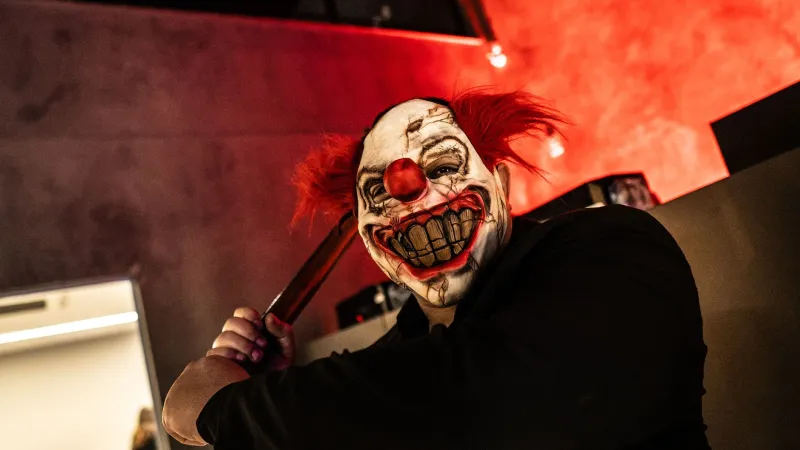
Somewhere in an undisclosed warehouse on the outskirts of a mid-sized American city, a grown adult is sobbing in the dark. They paid for this. They drove themselves here. They signed a document acknowledging that what's about to happen might genuinely mess with their head. And when it's over — if they make it through — they will almost certainly tell everyone they know.
Welcome to the new American leisure activity nobody saw coming: paying professionals to psychologically dismantle you.
The Waiver Is the First Warning
Let's start with the paperwork, because it says everything. Extreme haunted attractions like McKamey Manor — probably the most infamous name in the space — don't just ask you to sign a standard liability release. They hand you multi-page documents that read less like legal boilerplate and more like a hostage negotiation checklist. Participants acknowledge potential psychological distress. Emotional trauma. The possibility that they will not complete the experience. Some venues require proof of physical fitness. A few do background checks.
This is not a bit. This is not theater designed to look scary from a safe distance. The waiver is the experience's opening act, and its job is to make you genuinely question whether you should be here at all.
That doubt? That's the product.
Escape Rooms Grew Up and Got Dark
The mainstream escape room industry — now a $2 billion market in the US — spent its early years as a fun corporate team-building exercise. Solve the puzzle, unlock the door, grab drinks after. Wholesome stuff.
Then something shifted.
A growing subset of operators started pushing the format somewhere more uncomfortable. Rooms that don't just challenge your intellect but actively try to destabilize your sense of safety. Sensory deprivation elements. Actors who get uncomfortably close. Scenarios built around genuine phobias — claustrophobia, isolation, the creeping dread of being watched. Some of these experiences are now explicitly marketed not as puzzles but as psychological endurance tests.
The escape room isn't asking if you're smart enough anymore. It's asking how much you can take.
So Why Are People Lining Up?
Here's where it gets genuinely interesting, because the demographics of extreme horror tourism are not what you'd expect. It's not just adrenaline junkies and horror obsessives — though there are plenty of those. Surveys and anecdotal reporting from operators consistently describe a broad cross-section of participants: professionals in high-stress careers, people who describe themselves as anxiety sufferers, veterans, trauma survivors, and a notable contingent of people who specifically say they came because their everyday life feels emotionally numb.
That last group is worth sitting with.
There's a concept in psychology called the window of tolerance — the zone in which you can process experience without shutting down or spinning out. Chronic stress, emotional suppression, and the particular flatness that comes from living inside a screen for most of your waking hours can compress that window until almost nothing gets through. Therapists who work with trauma sometimes use controlled exposure to intense stimuli to help clients feel again.
These haunted warehouses are doing a rough, amateur, consumer-packaged version of the same thing. And people are finding it works.
The Luxury of Losing Control
There's a class dimension here that deserves some honesty. Premium extreme experiences aren't cheap. McKamey Manor has historically been free to enter — which is its own kind of terrifying flex — but the higher-end immersive horror events that have proliferated in cities like LA, New York, Chicago, and Austin can run anywhere from $75 to several hundred dollars for a single session. Some theatrical horror experiences blur the line between haunted attraction and performance art, charging festival prices for multi-hour psychological journeys.
This positions genuine fear as a luxury good. The ability to safely lose control — to be terrified in a context where you retain the power to stop it — is something you have to be able to afford. There's a dark irony in the fact that working-class Americans who deal with genuine precarity and uncontrolled fear daily aren't the target market. The target market is people who feel too safe, too insulated, too comfortable to feel anything sharp.
Fear, packaged and sold back to people who've been cushioned from it, is now a premium experience category. Somewhere, a marketing VP is very proud of this.
What the Darkness Is Actually Doing
Psychologists who study extreme experience describe something called the opponent-process theory of emotion — the idea that intense negative states are followed by a rebound of positive affect once the stimulus is removed. In plain English: the relief and euphoria after surviving something terrible feels genuinely incredible. Your brain floods with the good stuff. You feel alive in a way that a Netflix queue simply cannot replicate.
Extreme haunt operators know this intuitively even if they don't name it. The post-experience high is part of what they're selling. The community of survivors — the shared language of people who made it through — is part of the product too. There are Reddit threads, Discord servers, and YouTube channels dedicated entirely to extreme haunt culture. People don't just do these experiences; they organize their social identities around them.
This is where the commodification angle gets genuinely strange. What starts as a confrontation with your own psychological limits becomes a brand. A personality. A thing you are.
The Part Nobody Wants to Talk About
For all the legitimate psychological intrigue here, it's worth naming the shadow side plainly. Some of these experiences are not well-designed. Some operators are not thoughtful about aftercare, about the difference between productive discomfort and actual harm, about what happens when someone with undiagnosed PTSD walks through their door.
The industry is largely unregulated. Safe words and exit protocols exist in the more responsible corners of this world, but they're not universal requirements. And the culture of extreme haunt fandom, which valorizes completion and dismisses people who tap out, creates social pressure that can override someone's better judgment about their own limits.
The waiver protects the business. It doesn't protect you.
Fear as Mirror
What this whole phenomenon ultimately reflects back at us is something uncomfortable about American life right now. We are a culture that has built extraordinarily effective systems for avoiding difficult feelings — pharmaceutical, algorithmic, commercial — and then discovered, collectively, that avoiding everything difficult eventually makes you feel nothing at all.
So we pay someone to scare us. We sign the forms. We walk into the dark.
Maybe that's pathological. Maybe it's adaptive. Maybe it's just what happens when an entire society gets so good at managing discomfort that genuine experience starts to feel like a scarce resource worth paying a premium to access.
Either way, the lights are off, the actor is closer than you'd like, and somewhere in your chest something ancient and animal is very, very awake.
You paid for this. And honestly? It's working.