Nobody Home: The Creeping Horror of Realizing Everyone Around You Might Be a Character
There's a specific kind of dread that doesn't come from monsters or jump scares. It crawls in slower than that. It starts when you're watching a friend tell a story at dinner and you catch yourself thinking — is this the version they rehearsed? Not in a paranoid way. Just a quiet, terrible flicker. Like a fluorescent light buzzing one note off from normal.
That flicker? It's not going away. And the more time we spend living inside our own documentation, the louder it gets.
The Camera Changed Everything Before We Noticed
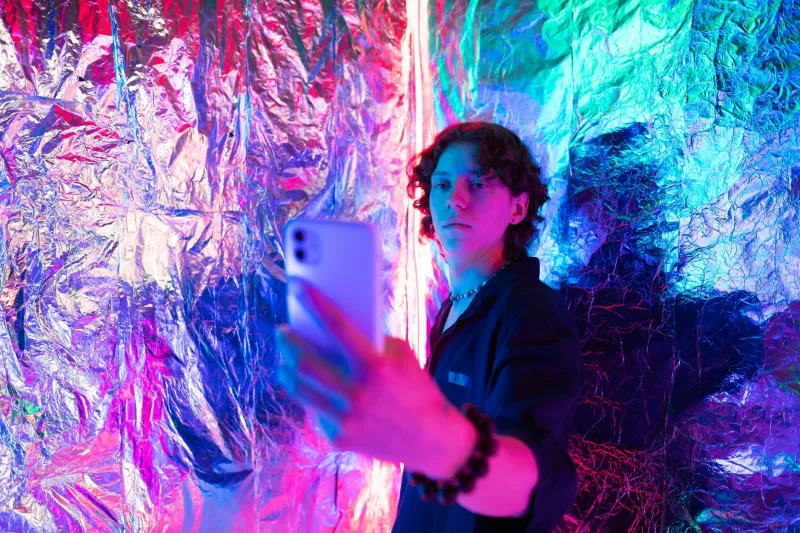
Here's the thing about surveillance culture that nobody really wants to sit with: it didn't just change how other people see you. It changed how you see yourself. The moment you started thinking about angles, about lighting, about which version of a story plays better — you became both the subject and the director of your own life. That's not a metaphor. That's a structural shift in consciousness.
Psychologists have been circling this for years without quite landing on it. We talk about "self-presentation" and "identity performance" like they're neutral academic concepts, but the lived experience of it is genuinely unsettling. You are editing yourself in real time. Not occasionally. Constantly. And so is everyone you know.
The horror isn't that people are fake. The horror is that the line between authentic and performed has dissolved so completely that the question itself might be meaningless now.
Your Friends Are Characters. So Are You.
Think about the last time you posted something personal online. Not a selfie — something that felt vulnerable. A bad day. A complicated feeling. A loss.
Be honest: did you write it once, or did you write it several times? Did you read it back? Did you think about how it would land?
Of course you did. We all do. And there's nothing wrong with that on its own — humans have always shaped the stories they tell about themselves. But the scale and speed of it now is different. We're performing for audiences that are always there, always watching, always ready to respond. The stage never goes dark. There's no backstage anymore.
What that produces, psychologically, is something genuinely strange. Researchers studying social media behavior have found that heavy users often struggle to access their own emotional states without first imagining how those states would be received. The internal experience gets filtered through the anticipated external response before it even fully forms. You don't just feel sad. You feel sad in a way you're already narrating.
That's not a horror movie premise. That's Tuesday.
When the Performance Becomes the Person
The uncanny valley — that nauseating almost-rightness that makes realistic robots feel horrifying instead of comforting — works because our brains are exquisitely tuned to detect the gap between authentic and imitation. We evolved to read each other. To sense when something is off.
But what happens when the imitation is the authentic? When someone has performed a version of themselves so consistently and for so long that it's simply who they are now?
This is where it gets genuinely dark. Because the answer isn't reassuring. It's not "oh well, then the performance becomes real and everything's fine." The answer is that you can no longer trust your own instincts about who someone is. The detector that evolution gave you — the one that reads microexpressions and vocal inflection and the tiny hesitations before someone speaks — that detector was built for a world where performance was occasional. Deliberate. Detectable.
We broke it. We broke it by making performance the default state.
The Paranoia Is Rational, Which Is the Worst Part
Here's what makes this particular horror so hard to shake: the suspicion is reasonable. When you look at someone's Instagram and feel like you don't recognize the person in the photos, you're not being crazy. When you have a conversation with someone and it feels scripted, you're not being paranoid. When you catch yourself performing emotions you actually feel because you've gotten so used to packaging them — that recognition is accurate.
The gaslighting move that our culture keeps making is to call this cynicism. To say that being skeptical of performed authenticity means you've gotten too online, too jaded, too disconnected.
But cynicism is when you stop believing good things exist. This isn't that. This is something more precise: the recognition that the tools we built to connect us have quietly rewired the nature of connection itself. That's not cynicism. That's diagnosis.
What Authentic Even Means Anymore
There's a corner of social media — and this is somehow both the most sincere and most unsettling development — dedicated to performing anti-performance. The no-makeup selfie. The raw, unfiltered crying video. The "I'm not okay" post that racks up hundreds of thousands of likes.
Which raises the question: if vulnerability is content, is it still vulnerability?
Maybe. Probably sometimes. But the fact that we can't tell — that the most emotionally exposed moments are now aestheticized and packaged and distributed for engagement — says something genuinely disturbing about where we've landed.
The horror isn't malice. Nobody sat down and decided to make human connection feel like watching a very good actor. It happened incrementally, through a thousand individually reasonable choices. Post this. Frame it this way. Don't post that. The algorithm rewarded certain kinds of self-presentation and punished others, and we adapted, because we always adapt, because that's what humans do.
And now we live in the result.
Living With the Flicker
So what do you do with this? The easy answer — get offline, be present, have real conversations — is both correct and insufficient. The rewiring has happened. You can't uninstall it by putting your phone in a drawer for a weekend.
What you can do is start treating that flicker of recognition as information rather than pathology. When something feels slightly off — when a conversation has the texture of a rehearsal, when your own emotional response arrives pre-packaged — that's not you being broken. That's your nervous system accurately reading an environment that has genuinely changed.
The horror of recognizing that everyone around you might be performing is survivable. It's even useful. It's the horror of clarity.
The thing to be scared of isn't the performance. It's the moment you stop noticing it.
Because that's when you've fully become the character. And the real you — whatever that was — has nobody left to come home to.