The Middle of Nowhere Is Where the Bodies Drop: Horror's Quiet Migration to Small-Town America
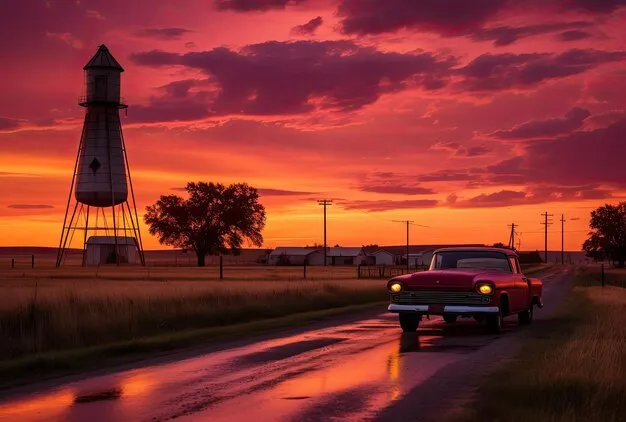
Photo: empty rural two-lane road at dusk with water tower small town america, via img.freepik.com
There's a scene you've watched a hundred times without realizing it: a two-lane road, a water tower with a town name you've never heard, and a stranger at a gas station who knows too much. That scene is the new center of gravity in American horror.
For decades, the genre ran on big cities. New York had its apartment buildings that ate tenants. LA had its cults and its sunshine rot. Chicago had its housing projects with things in the walls. The city was the monster because the city was the anxiety — density, anonymity, decay, the sense that millions of people could watch you die and nobody would look up.
That era's over. Horror packed the minivan and moved to a town with one stoplight.
The Geography of Dread Moved
Look at what's actually working right now, in film and in fiction. The haunted houses sit at the end of gravel roads. The cults meet in converted barns. The thing in the lake is in a lake you have to drive two hours to reach, past a Dollar General and a church sign with a passive-aggressive message on the marquee.
This isn't an aesthetic accident. It's a shift in what scares us.
City horror worked when the fear was strangers — the anonymous mass of people, any one of whom might be the killer. Small-town horror works because the opposite is true: everybody knows you, and that's worse. In a town of 900 people, there is no anonymity to hide in. Your business is public. Your history is permanent. The horror isn't that nobody will notice you're gone. It's that everyone will notice, and they'll all have opinions about it before the body's cold.
That's a genuinely American fear, and it's sharpening. The county that voted one way, the church everyone's family belongs to, the sheriff who's somebody's cousin — small-town horror understands that community and surveillance are the same thing when the population is small enough.
Why the Genre Followed the Anxiety
Horror has always been a seismograph. When the economy wobbles, we get movies about money and class — the haunted house you can't afford to leave, the vampire who's your landlord. When institutions lose credibility, the priest and the cop become the threat instead of the rescue.
The move to the small town tracks with a specific American feeling: the sense that the places we were told were safe — the heartland, the hometown, the wholesome middle — are holding something they'd rather not discuss. The horror out there isn't the city corrupting the countryside. It's the countryside revealing it was never innocent.
The found-footage and true-crime boom primed us for this too. Podcasts taught a generation that the most disturbing cases aren't in the city morgue. They're in the town where everyone agreed on a story and stuck to it for forty years.
What the New Setting Unlocks
Small-town settings also solve a craft problem that city horror had been struggling with: scale. A city is too big for one person to matter. A town of 900 makes every relationship load-bearing. The protagonist can't just avoid the threat — they have to see the threat at church, at the feed store, at Thanksgiving. You can't move away from a monster who's also your uncle.
And the isolation is real in a way urban isolation isn't. The nearest hospital is an hour. Cell service dies at the county line. When something goes wrong, help is a concept, not a phone call. Every horror writer knows the golden rule — cut your characters off from rescue — and rural America comes pre-cut.
The Town Is a Character Because the Town Is the Point
The best of this new wave doesn't treat small towns as backdrops. It treats them as accomplices. The horror works because the town needs the secret to stay buried — the economy depends on the plant, the reputation depends on the silence, the whole fragile social contract depends on nobody asking questions.
That's the sharpest anxiety of all: the fear that the communities we romanticize are held together by something they'd never say out loud. The city monster chases you. The small-town monster has known you since you were six, and it would really appreciate it if you stopped digging.
Horror didn't leave the city because the city ran out of nightmares. It left because we started being afraid of somewhere else. Watch where the genre goes — it's always a map of what keeps the country up at night. Right now, that map has a lot of gravel roads on it.